Transfer Station Info (Tip Fee $113.00/ton)
- Mt. Olive Mon-Fri 7:30am-3pm; Sat 7:30am-11am
- Parsippany Mon-Fri 7am-3pm; Sat 7:30am-11am
- No Rental Trucks
- Payment by Account, Check, Credit Card. No Cash
- Home
Morris County's
Environmental Resource
Welcome to the Morris County Municipal Utilities Authority's (MCMUA) website; MCMUA.com. The MCMUA Solid Waste Division implements recycling, solid and hazardous waste programs throughout Morris County. The MCMUA Water Division sells drinking water to several municipalities and water companies. The MCMUA is Morris County's environmental resource.
- Solid Waste
 Recycling
Coordinating and running recycling programs throughout Morris County. Garbage Disposal
Two transfer stations handle the disposal needs of Morris County. Collection Service
Residential, commercial and institutional recycling pickup Hazardous Waste
Managing household hazardous and eligible business waste. Compost Providing compost and mulch made from Morris County's vegetative waste
 Clean
Clean
Communities
Anti-Litter Programs Waste
Waste
Reduction Reuse Solid Waste
Planning Facility Inclusions Towns
Towns
Municipal Information - Water
 Water System
Wholesale drinking water provider.
Water System
Wholesale drinking water provider. Water Quality Keeping our water clean - Drinking water quality reports.
 Conservation Saving water because it is a valuable resource in so many ways.
 Education Resources to help learn about water and how to use it wisely.
 Open Space MCMUA working with Morris County to preserve open space
 - About the MCMUA
 Contacts
MCMUA board members, staff and more Directions
Maps, locations and directions to MCMUA facilities Public Disclosure
Information for the public we serve Current Legal Notices/Bids
Public Notices, Bids, RFPs, Quotes

Morris County
Municipal Utilties Authority
Transfer Station Info (Tip Fee $113.00/ton)
- Mt. Olive Mon-Fri 7:30am-3pm; Sat 7:30am-11am
- Parsippany Mon-Fri 7am-3pm; Sat 7:30am-11am
- No Rental Trucks
- Payment by Account, Check, Credit Card. No Cash
Household Hazardous Waste Disposal Days
The Morris County Municipal Utilities Authority holds disposal event days, in addition to the permanent household hazardous waste facility in Mount OIive, to provide Morris County residents with a safe, cost-free, and environmentally conscious way to properly dispose of their unwanted household items unable to into the regular trash.
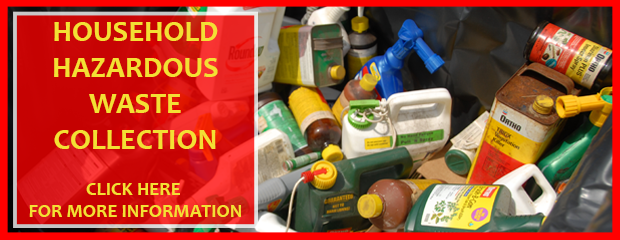
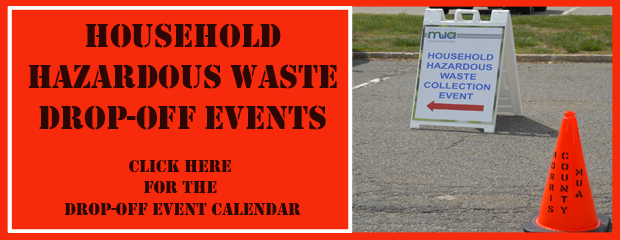
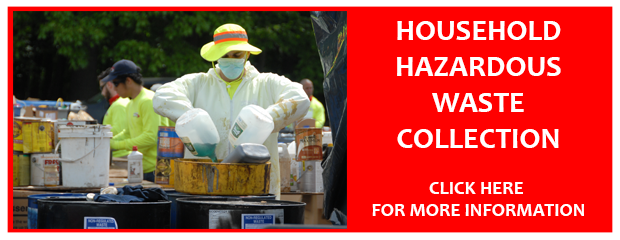
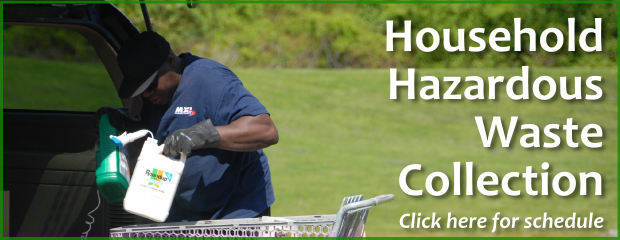
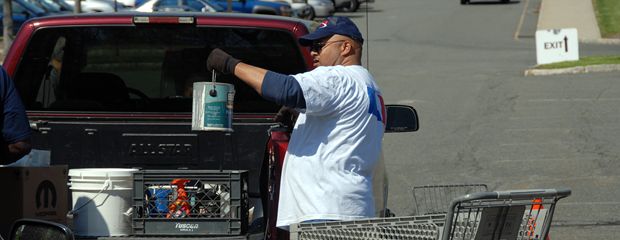
These events are held annually, two in the spring and two in the fall, from 9 a.m. to 2 p.m. at various locations around the County to provide equitable access to the program. Proof of Morris County residency is required; (current driver's license, valid lease, tax bill, or any other bill with a Morris County address). Individuals without proof of residency will not be permitted access to the event. Businesses and commercial generators are not permitted to dispose of the material at these events and must use the permanent HHW facility in Mount Olive by scheduling an appointment for disposal HERE.
2026 HHW Schedule
Click here for a copy of the 2026 household hazardous waste event day flyers which include directions to the different locations and a general listing of acceptable and unacceptable materials.
The MCMUA schedule of household hazardous waste disposal days is provided below. You can also use the MCMUA's permanent househld hazardous waste facility located in Mt. Olive which is available year-round by appointment only.
Schedule Appointment At Mt. Olive Permanent HHW Facility
- Saturday, April 25, 2026, 9am-2pm
Jefferson Township D.P.W.
1033 Weldon Road, Lake Hopatcong, NJ 07849
- Saturday, June 20, 2026, 9am-2pm
Chatham High School
255 Lafayette Avenue, Chatham Township, NJ 07928
- Saturday, September 26, 2026, 9am-2pm
County College of Morris - Parking Lot #1
214 Center Grove Road, Randolph, NJ 07869
- Saturday, October 24, 2026, 9am-2pm
Pequannock Valley Park
Marvin Road, Pompton Plains, NJ 07444

Hazardous Waste Materials
- Adhesives
- Aerosols
- Antifreeze
- Appliances (CFCs)
- Art & Crafts
- Asbestos
- Batteries (Auto & Boat)
- Batteries, Household (dry cell)
- Cell Phones
- Compressed Gas Cylinders
- Driveway Sealer
- Electronics
- Fire Extinguishers
- Fluorescents
- Gasoline
- Medical Waste
- Kerosene
- Mercury
- Motor Oil & Filters
- Muriatic Acid (HCl)
- Paints & Stains
- Pesticides
- Photo Chemicals
- Pool Chemicals
- Propane
- Rock Salt
- Smoke Detectors
- Solvents
- Wood with Lead Paint
Acceptable Materials at MCMUA Household Hazardous Waste Programs
- There are no maximum amounts of household hazardous waste that Morris County residents may bring per visit, except no more than 55 gallons of used motor oil and no more than 100 lbs of asbestos per person. Note: no one may drop off 100 lbs of asbestos multiple times as a means to dispose of more than 100 lbs of asbestos as part of the MCMUA's hazardous waste program.
- Materials will not be accepted in containers larger than five gallons in size.
- All materials must be in clearly marked containers with the contents identified.
Common examples of acceptable materials include the following:
- adhesives
- aerosol cans
- asbestos in small quantities, must be under 100 lbs., wet down, double-bagged, sealed with duct tape, and sized to fit into 55-gallon drums
- automotive cleaning products
- automotive fluids such as oil, antifreeze and brake, diesel, transmission and steering fluids, etc.
- automotive used oil filters
- batteries for car, boat, motorcycles and/or ATVs (lead-acid)
- batteries, if they are rechargeable (NiCd, NiMH, Lithium-Ion) and/or hazardous dry-cell batteries (button-cell and lithium). Note, all rechargeable batteries must be small enough to fit in a box no bigger than 12" x 6" x 4". As such, many e-bike, ATV, hover-board, etc. batteries will be too large, cannot be accepted and must be returned directly to the manufacturer. Alkaline batteries are not hazardous and are not accepted (put them into the garbage).
- caulks
- caustic cleaning materials
- cooking oils (vegetable, peanut oil, etc. can be new or used)
- corrosive liquids and solids
- driveway sealant and roofing tar if they contain coal tar or petroleum distillates
- fire extinguishers
- flammeable liquids (lighter fluid, diesel fuel)
- fluorescent light bulbs and CFLs (compact fluorescent lights) that contain mercury
- gasoline/diesel gas (must be transported in a certified gas can)
- household hazardous cleaning products - must be considered hazardous but note, most are not hazardous.
- kerosene
- muriatic acid
- nail polish and nail polish remover (acetone)
- oil-based paints and varnishes, stains, lacquers (liquid or solidified)
- pesticides, herbicides, fertilizers (bug sprays, bug killers, home defense and repellents)
- photography and printing chemicals (fixers, toners and inks)
- pool chemicals and chlorine
- propane cylinders (BBQ-sized propane cylinders cost $5/cyl. at the permanent HHW facility and there is no charge for camping stove-sized propane cylinders)
- solvents and paint thinners
- thermometers and thermostats containing mercury
Unacceptable Materials at MCMUA Household Hazardous Waste Programs
The following materials are unacceptable at HHW programs:
- Explosives or highly reactive materials since these may be dangerous! Always call first for safety instructions. DO
NOT bring these materials without prior authorization! These dangerous items include, but are not limited to the following:
- ammunition
- benzoyl peroxide
- bromine
- calcium carbide
- "Dangerous When Wet" materials e.g. sodium metal
- ethyl ether
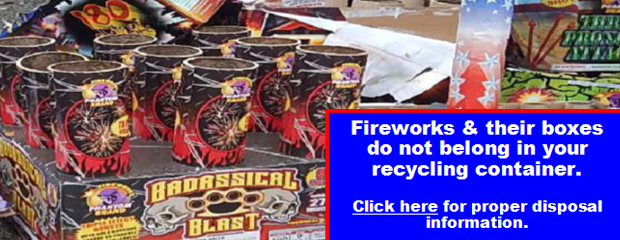
- fireworks
- isopropyl ether
- perchloric acid
- Pentachlorophenol (from older cans of Woodlife)
- picric acid
- Materials in containers larger than five (5) gallons in size
- Materials in unlabeled containers and/or containers with unknown contents
- E-waste and/or used consumer electronic waste is not accepted at one-day hazardous waste disposal events.
- Dried, hard, solid latex paint or empty paint cans; these are accepted for disposal at the transfer stations with other non-hazardous solid waste. Residents should remove the lids from these dried-out cans and dispose of both types into their household garbage.
- Latex or water-based paints are not hazardous and are not accepted at MCMUA hazardous waste disposal programs. Latex paint may be safely disposed of in the garbage when it is dried out. Dry out latex paint cans by stirring absorbent material such as cat litter into the paint. The paint will harden within a few minutes. Leave the lid off the can, put the lid and the can into the regular garbage. A hazardous waste handling fee of $2.00 per pound is charged for latex paint. Latex paint will not be accepted whatsoever during one-day hazardous waste disposal events.
- Appliances such as microwave ovens, washers, dryers; freon-containing appliances such as refrigerators, freezers, air conditioners, humidifiers
- Biologic agents
- Compressed gas cylinders (oxygen, acetylene)
- Rock Salt
- Construction materials such as wood, brick, treated lumber, asphalt, or concrete
- Radioactive materials or X-ray machines (ionizing)
- Regulated medical waste, including pharmaceuticals, syringes, sharps and needles
- Smoke and/or carbon monoxide detectors
- Tires