Transfer Station Info (Tip Fee $113.00/ton)
- Mt. Olive Mon-Fri 7:30am-3pm; Sat 7:30am-11am
- Parsippany Mon-Fri 7am-3pm; Sat 7:30am-11am
- No Rental Trucks
- Payment by Account, Check, Credit Card. No Cash
- Home
Morris County's
Environmental Resource
Welcome to the Morris County Municipal Utilities Authority's (MCMUA) website; MCMUA.com. The MCMUA Solid Waste Division implements recycling, solid and hazardous waste programs throughout Morris County. The MCMUA Water Division sells drinking water to several municipalities and water companies. The MCMUA is Morris County's environmental resource.
- Solid Waste
 Recycling
Coordinating and running recycling programs throughout Morris County. Garbage Disposal
Two transfer stations handle the disposal needs of Morris County. Collection Service
Residential, commercial and institutional recycling pickup Hazardous Waste
Managing household hazardous and eligible business waste. Compost Providing compost and mulch made from Morris County's vegetative waste
 Clean
Clean
Communities
Anti-Litter Programs Waste
Waste
Reduction Reuse Solid Waste
Planning Facility Inclusions Towns
Towns
Municipal Information - Water
 Water System
Wholesale drinking water provider.
Water System
Wholesale drinking water provider. Water Quality Keeping our water clean - Drinking water quality reports.
 Conservation Saving water because it is a valuable resource in so many ways.
 Education Resources to help learn about water and how to use it wisely.
 Open Space MCMUA working with Morris County to preserve open space
 - About the MCMUA
 Contacts
MCMUA board members, staff and more Directions
Maps, locations and directions to MCMUA facilities Public Disclosure
Information for the public we serve Current Legal Notices/Bids
Public Notices, Bids, RFPs, Quotes

Morris County
Municipal Utilties Authority
Join
6/9/26, 7PM Board Meeting
Join via Webex
or use the call in number: 408-418-9388 with Access code: 2336 984 7170.
Click to go to Board Meeting Webpage
Construction Alert:
Click here for info on Water Main Replacement on Pleasant Hills Rd. Randoplph starts June 9, 2026
Screened compost is sold out for the spring season. Free unscreened compost is available for residential pickup at our free piles at each facility . Click for Info. Wood mulch is still available for residential delivery.
Municipal Recycling Coordinators (MRCs)
This page is specifically for the Morris County municipal recycling coordinator (MRC) and others in related positions. It provides information regarding annual recycling tonnage reports, municipal recycling planning responsibilities specific to Morris County, information regarding mandated source separation recycling in Morris County.
MRC Responsibilities
These are the MRC’s responsibilities as required by the Morris County Solid Waste Management Plan (SWMP) and the Recycling Enhancement Act Municipal Tonnage Grant Program.
-
Checklist for Municipal Recycling Programs required by Morris County SWMP
Annual Responsibilities:
- Complete and submit recycling tonnage report to NJDEP by April 30 – Section 9.2(e)
- Create and mail notifications to generators (all residents, businesses, and institutions) of recycling opportunities and requirements – Section 9.2(f)
- Complete 3 recycling investigations per year – Section 8.6
- Submit the following to the MCMUA by April 30:
- Copy of recycling tonnage report
- Copy of notifications to generators
- Recycling and Solid Waste Program Report – Section 9.2(i)
- Attend at least 1 MCMUA-sponsored MRC meeting
Every Other Year Responsibilities:
- Attend at least 1 tour of a Class A recycling center organized by MCMUA
- Sign statement certifying attendance and commitment to attend tour during the next required year
Every 36 months Responsibilities:
- Review and revise master plan - Section 9.2.(c)
- Designate a municipal recycling coordinator if vacant - Section 9.1.
- Designate a municipal recycling enforcement coordinator if vacant - Section 8.6
- Complete recycling status reports for generators and site visit reports – Section 9.2(g)
- Complete a minimum of three recycling investigations per year
- Submit to MCMUA a report of illegal dumping, solid waste, and/or recycling enforcement activity for the previous calendar year
- Maintain a list of personnel in municipality capable of and obligated to enforce the municipal recycling ordinance and/or other municipal ordinances which pertain to illegal dumping, solid waste, and recycling. - Section 8.6
- NJDEP Tonnage Grant Webpage for detailed instructions, reporting, and expenditure forms.
- NJDEP Training video on annual municipal recycling tonnage grant application
- Sample letter to businesses requesting recycling tonnage information.
- MCMUA Annual Checklist for Morris Couty Municipal Recycling Coordinators - This is a checklist to to help ensure you are doing everything to comply with the NJDEP grant requirements and to maximize your grant request and proof of recycling in your municipality.
- Sample reporting form for businesses to submit recycling tonnage information.
- source separation requirements
- all mandated recyclable materials
- recommended recyclable materials
- unacceptable materials
- material preparation requirements
- materials collection and drop-off
- proper disposal of household hazardous waste
- Recycling Programs
- Single Stream Flyers & Signs
- Source Separation Recycling
- Vegetative Waste Recycling
- Household hazardous waste
- all current municipal recycling programs
- new programs it plants to implement to increase recycling
- additional tonnage needed to achieve the MSW Recycling Goal
- explanation of means to achieve the additional tonnage
- Below is a slide show presented by NJDEP's Ross M. Hull at the September 10, 2013 municipal recycling coordinator's meeting regarding NJDEP regulations, operating municipal recycling centers and filing recycling exemption notifications as necessary. Note, if using Microsoft's Internet Explorer, it must be version 8 or higher to view this slide show.
- Recycling Exemptions - Filing notifications exempting recycling activities from NJDEP approval or permitting.
As Needed Responsibilities:
Periodically Specified by MCMUA Responsibilities:
Additional Responsibilities if MRC is Also Enforcement Coordinator:
Additional requirements if the MRC also serves as the enforcement coordinator as designated by the municipal recycling ordinance:
Municipal Recycling Tonnage Reporting
In 2008, the Recycling Enhancement Act established funding for municipal recycling programs based on a $3/ton tax on all solid waste accepted at solid waste facilities in New Jersey. Municipalities are entitled to additional funding based on the tonnage of materials recycled by generators in the municipality (residents, businesses, and institutions). This funding can be used for a variety of activities to improve recycling rates in your municipality. (See expenditure guidelines here.)
In order for municipalities to receive this additional funding, the MRC is required to retrieve tonnage information from generators and complete a Recycling Tonnage Report each year. The MRC must submit the report to NJDEP by April 30, as well as submit a copy to MCMUA. The MRC is also required to submit an informal expenditure report to NJDEP of how grant funds were spent during the previous year. Municipal Tonnage Grant reporting is a lengthy process and MCMUA recommends that MRCs begin requesting tonnage reports from generators (businesses and institutions) at the end of January. Keep in mind that as MRCs, the easiest way to increase recycling rates in municipalities is to actually account for and report the recycling that is already happening.
Recycling Tonnage Reported by Markets
2025 - 2024 - 2023 - 2022 - 2021 - 2020
Recycling Tax ($3/ton) Paid By Towns in Tipping Fees
2025 - 2024 - 2023 - 2022 - 2021 - 2020
Municipal Tonnage Grant resources:
Notifying Generators
At least every 6 months, the MRC must notify all generators within the municipality about the following information:
Notifications should be customized to reflect recycling information specific to the type of generator (single- and multi-family residential, commercial, and institutional) and should be issued in a variety of formats in order to reach generators effectively. At least one of these notifications must be a direct mailing to each individual resident, business, and institution. - Section 9.2(f) Copies of these notifications must be submitted to MCMUA along with Recycling Status Reports if required that year.
The MRC must also be available to respond to questions from generators and to assist with compliance. Information for notifications and inquiries can be found on the following MCMUA webpages:
Recycle Coach
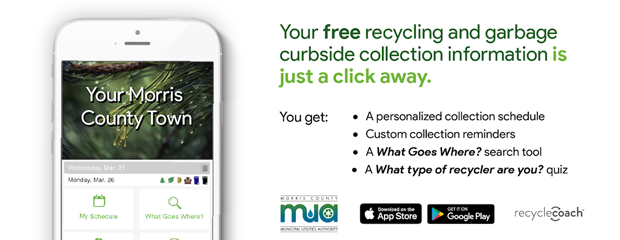
NJDEP pays to provide this technology free of charge to all residents to centralize recycling information for municipalities and counties in a single platform accessible through smart devices and computers. For quick access to your town’s information use MCMUA Recycle Coach here, or download the Recycle Coach app.
Recycling Status Reports & Site Visits
Periodically, MCMUA will require MRCs to obtain recycling status reports from specified generators at determined by MCMUA. MRCs will then be required to visit specific sites to determine the accuracy of those status reports. When this is required, MCMUA will provide MRCs with site visit report forms to evaluate the sites and request that generators take specific actions to correct any deficiencies. - Section 9.2(g)
Annual Recycling Program Report
Each year the MRC must submit a report to MCMUA describing: - Section 9.2(i)
Keep in mind that certain recycling activities require general or limited approval from NJDEP, while others are exempt but still require notification and filing with NJDEP. Read more about NJDEP Recycling Exemptions here.
Municipal Recycling Depots and Exemptions
Contact Information
Resources for Download

- High quality photos of household items (transparent PNGs)
- Flyers - All-In-One Single-Stream Recycling
- Recycling Flyers and Documents
- Transfer Station Disposal Flyers and Documents
- Litter, Clean Communities, Illegal Dumping
- Household Hazardous Waste Flyers and Documents
- Vegetative Waste Flyers and Documents
- Website PSAs
Mandated Source Separation Recycling
- Mandatory Source Separation Recycling - Explanation of why source separation recycling is the primary means of recycling in accordance with the Morris County Solid Waste Management Plan.
- List of Materials Mandated to be Source Separated and Recycled in Morris County 2007 (PDF or Word File). Please download, print, pay attention to, and distribute this document to anyone who lives or works in Morris County. Recycling of these materials is the law in Morris County.
- Exemptions From Source Separation Recycling Requirements - By law a procedure to assess requests by commercial
entities for exemptions from the Plan's requirements to source separate designated materials must be available, and this document is the Plan's recommended
procedure. Only municipalities can grant such exemptions. This would be an exemption only from source separation and not an exemption from recycling.
A repetition of that previous statement for emphasis: The granting of an exemption would be an exemption only from source separation and
not and exemption from recycling. The commercial generator that is issued such an exemption would then need to find a recycling facility that would separate the recyclables from the disposables and recycle the designated materials. Since no known such facility in New Jersey adequately operates like this, exemptions should not be granted by a municipality without total confidence that the materials will be recycled. To date and in Morris County, there are no known exemptions that have been granted.
Arcade - Fun and Games
Recent Videos
Planning Responsibilities
- March 2007 Recycling Plan Update to the Morris County Solid Waste Management Plan - This is a link to the entire Plan Update as adopted by the Board of Chosen Freeholders on April 11, 2007. This amendment was certified as approved for the most part by NJDEP in a certification dated October 10, 2007.
- Municipal Recycling Coordinator's "Reader's Digest" version of the March 2007 Recycling Plan Update. (PDF) This is not the full Plan Amendment but a reordered and reprioritized version of the document prepared to help the Morris County municipal recycling coordinators understand the Plan Amendment as it relates to municipal responsibilities, programs and enforcement efforts.
- Cover letter that accompanied guidance document provided below.
- Guidance Document for a Municipality (PDF) Implementing an Update to Its Recycling Ordinance and Other Recycling Requirements Resulting from the March 2007 Morris County Solid Waste Management Plan Amendment.
- Checklist for the Morris County Municipal Recycling Coordinator - This is a checklist of various activities related to both the adoption of the 2007 Recycling Plan Amendment, as well as general recycling coordinator duties. Please use this checklist to ensure you are performing the minimum duties required in Morris County as a municipal recycling coordinator.
- Model Municipal Recycling Ordinance for Morris County - PDF format or Word format. Use this model ordinance to update your municipal recycling ordinance to be consistent with the state and Morris County Solid Waste Management Plans as well as state regulations. This update of municipal recycling ordinances is required to be completed by each Morris County municipality by April 10, 2008, as part of the adoption of the March 2007 Recycling Plan Update.
- Model Multifamily Ordinance (PDF) revised for Morris County municipalities.